
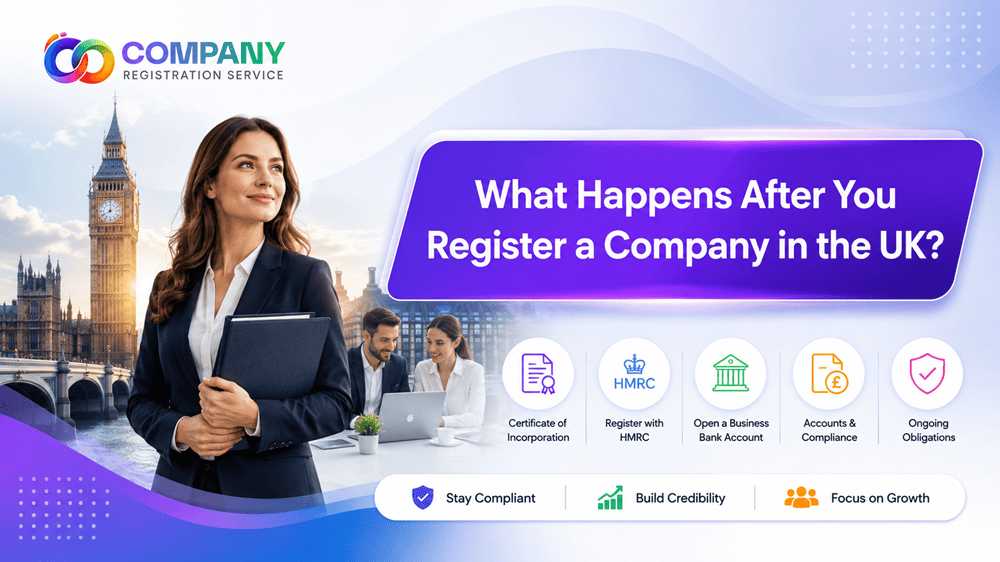
Starting a company in the UK seems like a big step. You get your name registered with Companies House, you will receive a company number and the business becomes a distinct legal entity. But UK company onboarding is just the beginning. Once the company is incorporated, directors are responsible for dealing with setting up taxes and statutory registers, opening bank accounts, accounting deadlines, compliance filings as well as carrying on with the day-to-day running of their business.
The hard work of a new founder, for many, begins once the certificate of incorporation arrives. So this guide outlines what you need to do after registering a company in the UK, where to go from there and how to be compliant as of day one.
First, You Receive Your Certificate of Incorporation
Your business only becomes official when the Companies house approves your application. Issuance of certificate of Incorporation. This is the document that verifies company name, company number, incorporation date and legal status.
This is important as banks payment processors suppliers accountants & some clients may request it before opening an account or contracting. Your company number is also with the business for life — you can change the company name but it will retain its original company number.
Table of Contents
ToggleAt this stage, you should also save your Companies House authentication code safely. You will need it to file company accounts, update company details, and submit your confirmation statement. Get details on Company Registration Service.
Key Things to Do After UK Company Registration
After incorporation, directors should not leave the company “as it is”. Instead, they should complete several important setup tasks.
|
Task After Registration |
Why It Matters |
Typical Timing |
|
Save incorporation documents |
Needed for bank, tax, and legal use |
Immediately |
|
Set up a business bank account |
Keeps company money separate |
As soon as possible |
|
Register for Corporation Tax |
Required once the company becomes active |
Within 3 months of trading |
|
Set up bookkeeping |
Supports tax returns and accounts |
From day one |
|
Check VAT position |
Needed if taxable turnover crosses the threshold |
Ongoing |
|
Register for PAYE |
Required before paying staff or directors through payroll |
Before first payday |
|
Track Companies House deadlines |
Avoids penalties and compliance issues |
Immediately |
HMRC states that a limited company must tell HMRC within 3 months of starting its tax accounting period if it becomes active for Corporation Tax.
Register for Corporation Tax with HMRC
If you start a new company, you may still believe Companies House automatically takes care of all the tax registrations. But that, it seems, is actually not. Companies House tells HMRC about a new company but the company must still register for Corporation Tax when it begins trading.
Your company generally comes into operation when it starts selling goods / services, receiving revenue, paying expenses for business activity or commences commercial operations. If the company has yet to commence trading, it can be an inactive company for Corporation Tax purposes. According to GOV.UK, a company can be dormant from the moment it is incorporated until its first business transaction takes place.
To register you usually need your company number, when your business started trading, registered office address, accounting period and company UTR. After incorporation, the official office receives the Unique Taxpayer Reference letter from HMRC. Looking for a Company Registration in England?
Open a UK Business Bank Account
Having a business bank account will make it easier for you to separate your company money with personal money. It is important to keep clean financial records since a UK limited company is legally separate from its owners. In addition, a separate address simplifies the accounting and promotes a more professional image for your companies.
The majority of banks will require your Certificate of Incorporation, a company number, details about the directors, proof of identity and address, nature of business and expected turnover. Extra checks around this step may also be needed for non-UK residents, which depends on your chosen bank or fintech provider.
This might seem like an easy thing to do at first using a personal account but later it may create confusion from an accounting perspective. So, getting a business account very soon is one of the best post-registration tasks.
Set Up Bookkeeping from Day One
With good bookkeeping you can save your business from stress later on. You would record sales, invoices, costs, bank transactions, payment receipts payroll VAT director loans dividends asset purchases etc.
Most founders do this only when the first tax deadline is fast approaching. But that can go hand in hand with lost invoices, poorly understood expenses, and accounts done last minute. And, instead of DIYing from the get-go, go with accounting software or hire an accountant.
Having a clean bookkeeping helps you to answer at the ground level questions like what profit we made? What tax may be due? Which invoices remain unpaid? Can we hire, invest or grow? Get details on Company Registration in UK.
Understand Your Annual Accounts and Tax Return Deadlines
Following a company formation in the UK, your business is typically required to submit annual accounts directly with Companies House and a Company Tax Return with HMRC. These are different obligations (even though the numbers sometimes are connected).
According to the GOV.UK website, first accounts should be filed with Companies House 21 months from the company registration, annual accounts 9 months after a company’s financial year ends, Corporation Tax is due 9 months and 1 day after your accounting period end, and the Company Tax Return must be filed within 12 months of your accounting period end.
|
Filing or Payment |
Where It Goes |
Standard Deadline |
|
First company accounts |
Companies House |
21 months after incorporation |
|
Annual accounts |
Companies House |
9 months after financial year end |
|
Corporation Tax payment |
HMRC |
9 months and 1 day after accounting period end |
|
Company Tax Return |
HMRC |
12 months after accounting period end |
|
Confirmation statement |
Companies House |
At least once every year |
Missing these deadlines can lead to penalties, interest, and damage to your company’s compliance record.
File a Confirmation Statement Every Year
All UK companies are required to file a confirmation statement with Companies House at least once per annum. This is a confirmation that the Company information on the public register remains true and accurate.
Information like registered office, directors, shareholder detail, SIC code, share capital and people with significant control are covered under confirmation statement. Companies House guidance clearly states that every company — including non-trading/dormant companies — is required to make a confirmation statement at least once per year.
This filing is not a substitute for annual accounts. It is a separate requirement. Hence, it is recommended for the directors to keep tabs on both timelines. Looking for a Company Registration in London?
Check Your VAT Registration Position
Not every new UK company needs to register for VAT immediately. However, you must monitor taxable turnover carefully.
The current UK VAT registration threshold is more than £90,000 in taxable turnover. GOV.UK states that a business must register for VAT if it goes over the registration threshold or expects to do so.
|
VAT Situation |
What It Means |
|
Taxable turnover below threshold |
VAT registration may not be required |
|
Taxable turnover above £90,000 |
VAT registration normally required |
|
Voluntary VAT registration |
Possible even below the threshold |
|
Taxable turnover below £88,000 after registration |
VAT deregistration may be optional |
Some companies register voluntarily because they sell to VAT-registered clients, want to reclaim input VAT, or need a stronger commercial image. However, VAT adds record-keeping and filing duties. So, directors should take advice before registering voluntarily.
Register for PAYE If You Pay Staff or Directors
Many businesses register for payroll as an employer if the company is self-contained and hires employees or pays directors. PAYE also assists HMRC in collecting Income Tax and National Insurance from wages.
According to website GOV.UK, employers must register before the first payday and cannot register earlier than two months prior to starting paying people.
After PAYE is activated, the business needs to accurately run payroll; it has to pay employees and issue payslips on time every month, report payments to HMRC in real time and retain payroll records. This needs to be handled with care even by small companies, particularly where the director wishes to take a salary. Get details on Company Registration in UAE.
Keep Company Registers and Legal Records
A UK limited company must maintain proper statutory records. These records may include directors, shareholders, people with significant control, share allotments, transfers, resolutions, and meeting decisions.
Although small companies often have simple structures, record-keeping still matters. For example, if shares change hands, a director resigns, or the registered office changes, the company must update its records and usually notify Companies House.
Good records also help during bank reviews, investor checks, due diligence, funding applications, or company sale discussions.
Verify Identity for Companies House Requirements
UK company law has changed. Companies House has introduced identity verification to improve transparency and reduce misuse of companies. The official Changes to UK Company Law guidance says anyone setting up, running, owning, or controlling a UK company must verify their identity.
From 18 November 2025, identity verification became a legal requirement with a 12-month transition period for many existing directors and people with significant control.
For new and existing company owners, this means identity checks now form part of normal company compliance. Directors and PSCs should check their due dates and complete verification through GOV.UK One Login or an Authorised Corporate Service Provider. Looking for a Company Registration in KSA?
Build Your Company’s Operational Setup
After the legal setup, you should make the company ready to trade. This may include setting up a professional email address, website, domain, contracts, invoice templates, payment gateway, insurance, data protection process, and supplier accounts.
Depending on your business activity, you may also need licences, industry approvals, local council permissions, import/export registrations, or professional insurance.
For example, a recruitment company, food business, construction contractor, care provider, finance business, or ecommerce importer may face extra compliance steps. Therefore, incorporation alone does not mean the business can legally start every type of activity.
Common Mistakes After Registering a UK Company
New founders often make avoidable mistakes after incorporation. The most common ones include ignoring HMRC registration, missing the confirmation statement, mixing personal and company money, forgetting VAT monitoring, not keeping receipts, paying dividends without checking profits, and using the registered office carelessly.
Another common mistake involves treating company money as personal income. A limited company’s bank balance belongs to the company. Directors must extract money properly through salary, dividends, reimbursed expenses, or director loan arrangements. Get details on Company Registration in India.
Why Professional Support Helps After Incorporation
A company formation service can help you register a company. However, a good company registration service should also guide you after incorporation. That support can include Corporation Tax registration, VAT advice, PAYE setup, bank account guidance, confirmation statement reminders, registered office support, and accounting coordination.
This is especially helpful for non-UK residents, first-time founders, ecommerce sellers, consultants, contractors and those growing businesses. The company is set up with the right tools and starts clean so they can avoid expensive corrections along the way.
Related Articles:
» Company Registration in Oman
» Company Registration in Abu Dhabi
» Company Registration in Dubai
» Company Registration in Jeddah
» Company Registration in Riyadh
Post-Registration in the UK: Essential Next Steps for Your Company
Now, after you register a UK company what to do next? Put simply, your business is registered, but you have to make it operational and compliant. Tax registration, banking, bookkeeping, Companies House filings, VAT checks, PAYE duties, identity verification and statutory records.
As such, do not consider incorporation the home stretch. Consider it the first step in a real business. Your UK company can remain compliant, continue to appear professional and grow with confidence when provided the right support.
FAQs: What Happens After You Register a Company in the UK?
1. What is the first thing to do after registering a company in the UK?
Saving your incorporation documents, company number, and authentication code Letter from HMRC From there, you can open a business bank account and bookkeeping.
2. Do I need to register for Corporation Tax after company formation?
Yes, if your company becomes active. You must tell HMRC within 3 months of starting business activity.
3. Can my UK company stay dormant after registration?
Yes. The company can remain dormant if it is not trading, generating income or conducting business activity. However, it still has to comply with Companies House filing obligations.
4. Do I need a business bank account for a UK limited company?
A company is a legal entity in its own right so it is very clear that you should have a separate business bank account as well. It also keeps accounts clean.
5. When are first company accounts due?
First accounts are usually due to Companies House 21 months after incorporation.
6. What is a confirmation statement?
A confirmation statement is an annual Companies House filing that confirms your company details are correct and up to date.
7. Is VAT registration compulsory after company registration?
Not always. VAT registration normally becomes compulsory when taxable turnover goes over the UK VAT threshold.
8. What is the UK VAT registration threshold?
The current VAT registration threshold is more than £90,000 in taxable turnover.
9. Do directors need PAYE?
PAYE may be required if the company pays directors or employees through payroll.
10. What records should a UK company keep?
A business needs to maintain its books of accounts, invoices, bills and receipts, bank statements, payroll records, details of the shareholders, members directors and PSC.
11. Do UK company directors need identity verification?
Yes. Companies House has introduced identity verification requirements for directors and people with significant control.
12. Can a company registration service help after incorporation?
Yes. A professional company registration service can help with tax registration, compliance reminders, bank account guidance, VAT, PAYE, and ongoing company administration.