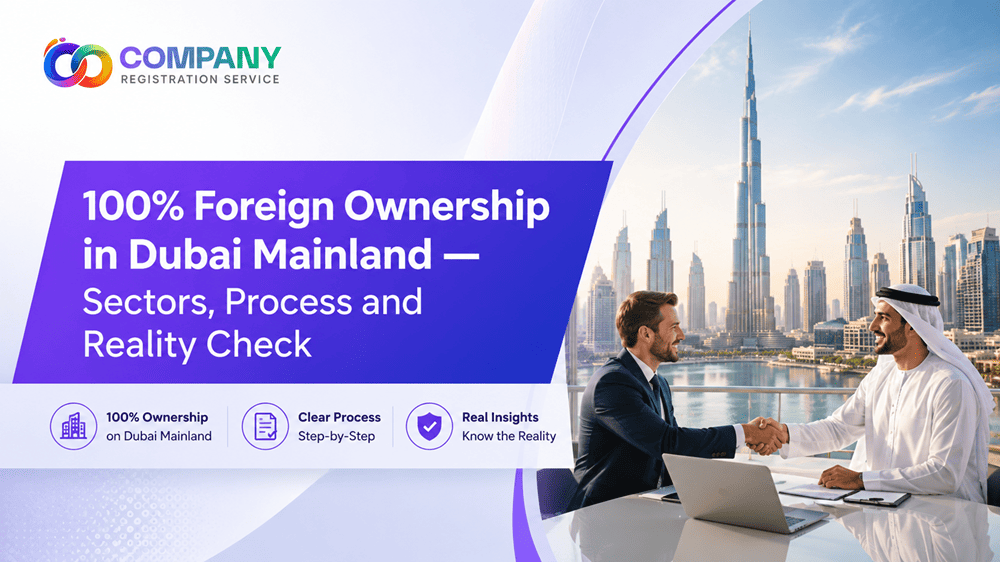
The Dubai mainland has changed a lot in the last few years. Earlier, many foreign investors believed they needed a UAE national partner to own 51% of a mainland company. However, that old assumption no longer applies to most business activities. Today, 100% foreign ownership in Dubai mainland is possible across many commercial, industrial, and professional activities, depending on the exact license activity and approval requirements.
For entrepreneurs, this is a big shift. You can now start a mainland business, serve clients across the UAE, rent office space anywhere in Dubai, apply for visas, open a corporate bank account, and keep full control of the company shares in many cases. Still, the reality is not as simple as “every business gets 100% ownership automatically.” The UAE Ministry of Economy confirms that investors of all nationalities can establish and fully own companies in the UAE, while local authorities and strategic-impact activity rules still matter.
What Does 100% Foreign Ownership in Dubai Mainland Mean?
100% foreign ownership in Dubai mainland means a non-UAE national can own all shares of an onshore company registered with the relevant Dubai licensing authority, without giving 51% shareholding to an Emirati partner.
In simple words, you can legally hold the full equity of the company. Therefore, you control ownership, profit distribution, share transfer, and future business decisions, subject to the company’s memorandum, license conditions, and UAE law.
Table of Contents
ToggleHowever, ownership and operational approvals are not always the same thing. Some activities may still need third-party approvals from government departments, ministries, regulators, or municipalities. Moreover, certain activities with strategic impact may carry additional ownership conditions, board requirements, or special controls. The UAE has specifically noted that full ownership applies according to activities identified by competent local authorities and the list of strategic impact activities. Get details on Company Registration in Dubai.
Why Dubai Mainland Still Attracts Foreign Investors
Dubai mainland remains popular because it gives wider market access than many free zone structures. A mainland company can usually trade directly across the UAE, work with local clients, bid for certain contracts, and open branches more easily, depending on its license.
In addition, Dubai has a strong business reputation. Investors choose it for logistics, banking access, international connectivity, low personal income tax environment, and government-backed digital services. As a result, mainland company formation has become a practical option for consultants, traders, contractors, ecommerce firms, manufacturers, restaurants, clinics, agencies, and many service providers.
Most importantly, the ownership reform removed one of the biggest mental barriers for foreign investors. Earlier, founders worried about control. Now, in many sectors, the conversation has moved from “Who will hold 51%?” to “Which activity, structure, approval, and bank route suits the business?”
Key Sectors That May Allow 100% Foreign Ownership
Dubai’s approved activity list is broad, but the exact answer depends on the selected business activity. Therefore, you should not rely on generic online packages. You need to match your activity code with ownership eligibility and external approval rules.
| Business Area | Common Mainland Activities | Ownership Reality |
| Trading | General trading, electronics trading, building materials, garments, foodstuff trading | Often possible, but activity scope and import rules matter |
| Professional Services | Management consultancy, marketing, IT consultancy, design, training | Commonly suitable for foreign-owned structures |
| Industrial & Manufacturing | Light manufacturing, packaging, assembly, production | Possible in many cases, but premises and approvals may apply |
| Technology | Software development, cyber services, IT infrastructure, digital platforms | Usually attractive for mainland setup, depending on activity |
| Real Estate & Construction Support | Brokerage, contracting support, maintenance, interior fit-out | May need special approvals or qualifying requirements |
| Healthcare & Education | Clinics, training centres, nurseries, medical services | Ownership may be possible, but regulator approval is essential |
| Food & Hospitality | Restaurants, cafés, catering, cloud kitchens | Usually possible with Dubai Municipality and location approvals |
| Logistics & Transport | Freight, delivery, transport support, storage | May need transport, customs, or municipal approvals |
Earlier, 100 percent foreign ownership was approved for several activities in renewable energy, space and agriculture as well as manufacturing by the UAE. But, in reality Dubai mainland set up the activity code on the license decides the path. Looking for a Company Registration in Dubai Free Zone?
Activities With Strategic Impact: The Reality Check
Some business areas remain sensitive because they affect national interest, security, infrastructure, or regulated public services. These are usually called strategic impact activities. The UAE Ministry of Economy designates strategic significance for activities under Cabinet Resolution No. 55 of 2021, and notes that these activities can either be excluded from automatic 100 ownership or may need regulatory approval to engage in full ownership.
For example, this may include sectors related to defence & security, certain telecoms, banking and insurance services (including exchange houses), pilgrimage services and further regulated space. The specific treatment can however be subject to change based on activity classification and authority review.
Therefore, a serious investor should ask three questions before paying for a license package:
| Question | Why It Matters |
| Is my exact activity eligible for 100% foreign ownership? | Similar-sounding activities can have different rules. |
| Do I need external approval? | Some regulators approve the business before or after license issuance. |
| Will banks accept this activity and structure easily? | Banking is often where weak setup advice fails. |
Dubai Mainland vs Free Zone for Foreign Ownership
Many founders ask whether they should choose mainland or free zone. Both can offer foreign ownership. However, they serve different business models.
| Factor | Dubai Mainland | Dubai Free Zone |
| Ownership | 100% possible for many activities | Usually 100% foreign ownership |
| UAE Market Access | Direct access across UAE | May need distributor/permits for mainland trade |
| Office Options | Flexible across Dubai, based on license | Usually within the free zone or approved flexi options |
| Government Contracts | Often stronger route | May be limited depending on project |
| Retail/Physical Presence | Better for shops, clinics, restaurants, local services | Limited unless special approvals apply |
| Banking Perception | Often strong when activity is clear | Depends on free zone, activity, and substance |
| Best For | UAE-facing businesses | International, digital, export, holding, consultancy models |
Simply put, the mainland works for you when your customers / staff / suppliers & operations are within Dubai & UAE. However, when the bulk of your clients are situated outside the UAE, or you require a full remote structure that is relatively light to set up – then a free zone might be for you. Get details on Company Registration in UAE.
Step-by-Step Process for 100% Foreign Ownership in Dubai Mainland
The setup process looks simple from outside, but each step affects cost, approvals, visas, and banking. Therefore, the smart approach is to plan before filing.
1. Choose the Exact Business Activity
First, define what your company will actually do. For example, “consultancy” is too broad. You may need management consultancy, marketing consultancy, IT consultancy, engineering consultancy, or another specific activity.
This step matters because your activity decides ownership eligibility, trade name wording, external approvals, office requirement, and visa quota.
2. Select the Legal Structure
Most foreign investors choose an LLC or a sole establishment/professional structure, depending on the activity and ownership plan. The UAE Ministry of Economy notes that full foreign ownership can apply to legal structures under the Commercial Companies Law, including LLCs and joint stock companies, subject to relevant rules.
3. Reserve the Trade Name
Next, you reserve a company name. The name must follow UAE naming rules. It should not breach public morals, copy an existing business, include restricted words without approval, or misrepresent the activity.
4. Get Initial Approval
Initial approval means the authority has no objection to you starting the licensing process. However, it is not the final license. In addition, external approvals may still apply.
5. Prepare MOA or Local Service Agent Agreement, If Required
For many LLC activities, foreign investors may hold 100% shares. However, some professional or regulated structures may still need a local service agent rather than a shareholder. This agent does not own the company, but may support administrative representation where required.
This point often confuses investors. A local service agent is not the same as a 51% local sponsor.
6. Arrange Office or Business Address
Dubai mainland companies usually need a registered address. Depending on the activity, you may need an Ejari, physical office, shop, warehouse, clinic, kitchen, or approved workspace.
7. Submit Final Documents and Pay Fees
After approvals, documents, lease, and legal forms are ready, you submit the final application and pay government fees. Once approved, the authority issues the trade license.
8. Apply for Establishment Card, Visas, and Bank Account
After license issuance, you can proceed with immigration file, establishment card, investor visa, employee visas, corporate tax registration, VAT registration if applicable, and corporate bank account opening. Looking for a Company Registration in Ajman?
Common Costs Investors Should Expect
Costs change depending on activity, approvals, office space, visa quota, and government fee updates. Still, investors should budget beyond the license headline price.
| Cost Item | What It Covers | Practical Note |
| Trade license fee | Government license issuance | Varies by activity |
| Name reservation & initial approval | Pre-licensing steps | Usually smaller but required |
| MOA/legal documents | Company constitution and notarisation | Depends on structure |
| Office/Ejari | Registered business address | Can be a major cost factor |
| External approvals | Sector regulator approvals | Applies to selected activities |
| Visa costs | Investor and staff visas | Depends on number of applicants |
| Banking support | Account preparation and compliance file | Not a government fee, but often useful |
| Corporate tax/VAT support | Tax registrations and filings | Important after incorporation |
A cheap license may become expensive if the activity is wrong, the office does not meet rules, or the bank rejects the account. Therefore, never compare setup quotes by price only.
Reality Check: What Investors Often Misunderstand
The biggest myth is that 100% ownership means zero restrictions. That is not true. Full share ownership gives control, but the business must still comply with licensing, immigration, tax, labour, municipality, and banking rules.
Another common misunderstanding is that Golden Visa status automatically changes ownership rules. In practice, ownership depends mainly on the business activity and legal structure, not only on visa status.
Also, many investors think the mainland is always better than the free zone. That is not correct either. Mainland is excellent for UAE-facing business. However, a free zone can still be better for international consulting, holding companies, digital services, and lean startups.
Finally, bank account opening deserves serious attention. Banks check ownership, activity, invoices, website, office, business model, source of funds, nationality risk, and expected transactions. As a result, a properly planned company file has a much better chance than a rushed setup. Get details on Company Registration in Abu Dhabi.
Documents Usually Required
Most Dubai mainland company formation cases require basic KYC and business documents.
| Document | Usually Needed From |
| Passport copy | Shareholder and manager |
| UAE visa or entry stamp | If available |
| Emirates ID | UAE residents |
| Passport-size photo | Visa and KYC files |
| Trade name options | Applicant |
| Business activity details | Applicant/consultant |
| Office lease/Ejari | Company |
| External NOC/approval | For regulated activities |
| Corporate documents | If shareholder is a company |
Requirements may vary. Therefore, a document checklist should always follow the selected activity, shareholder nationality, and legal form.
How Company Registration Service Helps
Company Registration Service helps investors understand the real route before they spend money. We review your activity, ownership eligibility, legal structure, approval requirements, office options, visa needs, and banking readiness.
Moreover, we explain what is possible and what may create delays. We do not push a mainland license when a free zone fits better. Likewise, we do not recommend the cheapest activity when it can block banking or future expansion.
Our role is simple: help you set up a Dubai company that can actually operate, invoice, hire, bank, and grow.
Related Articles:
» Company Registration in Sharjah
» Company Registration in Oman
Dubai Mainland Business Setup: The Real Investor Perspective
100% foreign ownership in the Dubai mainland has made Dubai far more attractive for global entrepreneurs. Foreign ownership of the entirety of a company (without a UAE national shareholder) in various sectors is now possible. But the bottom line still depends on your precise activity, can we say that you have an attractive business model and needs regulatory approvals and will need an office to operate in Dubai and plan a banking.
So think of company formation not in the way that you purchase a license but as a business decision. Dubai mainland with the correct setup can provide you 100% ownership, excellent access to the local market, and a more feasible location for growth in the UAE and region.
FAQs: 100% Foreign Ownership in Dubai Mainland
Yes, depending on the business activity and legal structure, foreigners can own 100% of several Dubai mainland companies. In contrast, certain strategic or regulated activities may require special approvals.
There is no longer a requirement for a 51% local sponsor in various commercial and industrial sectors. There are professional or regulated activities that still need to have a local service agent or authority approval.
A local sponsor usually refers to a UAE national shareholder under the older structure. A local service agent, however, does not own shares and mainly supports administrative representation where required.
No. Most activities may allow full ownership, but strategic-impact sectors and regulated activities may carry special conditions, approvals, or ownership limits.
Dubai mainland is better for businesses targeting UAE clients, retail operations, government contracts, and local expansion. However, free zones may suit international, remote, or export-focused businesses.
Generally, a Dubai mainland license allows wider UAE market access. Still, some goods and services may need extra permits, customs approvals, or regulator permissions.
A mainland license can support bank account opening, but approval is not automatic. Banks review activity, shareholders, business proof, office presence, and compliance documents.
Usually, yes. Most mainland companies need a registered address or Ejari. The exact office requirement depends on the license activity and visa needs.
Yes, in many eligible activities, a foreigner can be the sole shareholder and manager. However, the final structure depends on the chosen legal form and authority rules.
Many professional activities allow foreign ownership, but some may require a local service agent or specific approvals. Therefore, activity checking is essential before setup.
Simple activities can move quickly when documents are ready. However, regulated activities, office approvals, external NOCs, or banking preparation can extend the timeline.
The safest way is to confirm the activity code, ownership eligibility, approval requirements, office needs, visa plan, and banking file before paying for the license.